Sunday, March 31, 2013

Thinking about Chicken Paddocks

We have been free-ranging our little flock of four chickens.  They are good egg producers, with mostly superior quality.  We attribute the quality to the amount of protien the chickens obtain by freely attending to the most productive (i.e., wormy) areas of our property.

The problem is that we are planting beds.  We like flowers and plants growing there.  The chickens dug up and destroyed my wife's daffodill bed.  They dug up my row of onions, wiping out mostly all of my onion plantings in one location.  (Fortunately, they have not yet destroyed my other three onion beds.)

We just acquired six additional chickens.  A flock of ten could be destructive to our planting efforts.  Therefore, we are thinking of a means to contain our chickens.

Paul Wheaton's Raising Chickens 2.0: No More Coop and Run has some analysis on keeping chickens.

A thread on Permies discusses the chicken paddock shifting concept and throws out ideas here and there.

A mobile chicken coop is foremost on our thoughts now.  That will be needed if we are to paddock shift the chickens.

Possible construction materials for light weight coop that can be moved:
  1. Mesh wire;
  2. Polyethylene tubing;
  3. Metal tubing.
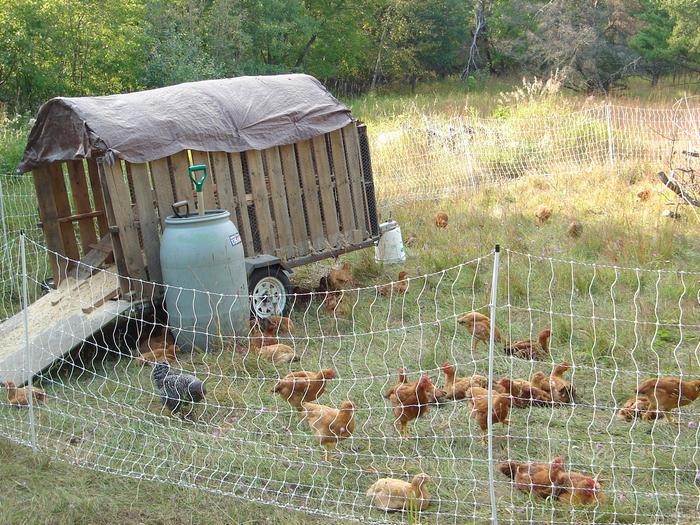
Alternatively, find an old trailer like the one pictured above.  May visit my neighbor to see about his broken down trailers.  He wants to sell one.

Most chickens do not fly over the floppy plastic netting.  They like to fly up and light on a taught top, then hop on.  The floppyness of a soft plastic wire netting keeps them from going over without wing clipping.  If you get a rogue, then you can hobble her.  


Sunday, March 17, 2013

paddock shifting video by greg judy

Here is a video of a presentation by Missouri farmer Greg Judy on paddock shifting.  Very nice concept.


Saturday, March 16, 2013

Chicken Flock Additions

We are stocking up on our depleted chicken flock. We now have only four chickens, two of which are poor producing Production Reds.
We aimed to buy hens that would provide a variety of egg colors.

The first addition is pictured to the left, ostensibly the Ameraucana. This breed produces medium-sized "Easter" eggs, light blue-greensish in color. We bought ours from the local feed store.

This chick, like most sold by commercial hatcheries, is more likely a mongrel rather than a true breed. Of course, since we are not breeding chickens that is perfectly fine with us.

We also bought two Buff Orpingtons. These chickens are reputed to docile and are average brown egg layers. This breed tends to become broody. Because they are docile, they are generally at the lower end of the chicken pecking order.

These birds are "dual purpose" and were originally raised for meat birds. Generally speaking, meat chickens do less well free-ranging as our girls live.

Finally for the chicken variety, we bought three silver Wyandottes from a local Spindale, North Carolina, breeder.  These chicks were raised by the grandfather of an employee of Oakland Feed and Seed in Spindale.

They were straight run chicks, meaning we do not know if we bought three hens, three roosters, or any combination thereof.  The good news is my wife said that we may get to keep a rooster if we have one in the three chicks.

The Wyandotte breed is much like the Buff Orpingtons.  They also lay brown eggs, maybe slightly more productive. They are docile chickens.

Lastly, what flock would be complete without some guinea fowl.  We bought six to add to our one guinea.  Guinea fowl are great tick-eaters, as well as other pests.  This is the first purpose.

We also are very happy with our guinea's defense of the chicken flock.  All his other species mates were killed by predators going into the winter.  However, our lone guinea survived and is the rooster of our flock of four free-ranging hens.  He watches for hawks, stands off dogs, and chirps at strangers and for lost hens.  He does a really good job in this capacity.

Guineas are also capable of producing some decent meat.  I haven't tasted guinea but it is said to be a cross between turkey and chicken, or a juicy pheasant flavor.


Friday, March 15, 2013

Vermicomposting: Red Wriggler Composting Worms

I ordered 2,000 Red Wiggler(Eisenia Foetida) composting worms from Uncle Jim's Worm Farm.  These are Pennsylvania worms so they will have to adapt to the western North Carolina heat.  We intend to feed the worms food scraps and horse manure.

Eisenia Foetida is a species of earthworm that lives on decaying material.  Colorado State published an article, Vermicomposting Horse Manure, which discussing setting up windrows.

Here is a blog post about how to rotate the worms and incorporate them into fertilizing gardens with chickens, TheModernHomestead blog, Raising Earthworms to Feed the Flock

Friday, March 8, 2013

Bio-Retention Water Catchment

Here are some images taken from the NC Water Conservation program handbook.  First, the diagram showing contours of the backyard wetland construction:


Next, a selection of drought tolerant wetland plants.


Here are the rain garden shrubs and perennial plants:


Below, some rain garden zone plants:


Here are some shallow water wetland plants:


Finally, some deep water plants.


Friday, March 1, 2013

Here is a picture of my brassicas (cauliflower, brussel sprouts, cabbage, and broccoli) growing in the soil cube mixture.  I followed the recipe of the soil cube instructions to make up my mix.

The seedlings are a bit spindly.  I will move my light source closer down toward the seedlings today and observe as to whether that improves their spindliness.

I also need to buy another grow bulb as I only have one installed in my grow tub right now.