Showing posts with label husbandry. Show all posts
Showing posts with label husbandry. Show all posts
Thursday, November 5, 2015
Piglets!
Our American Guinea Hog Comfrey, who is about one year old now, farrowed her first litter of piglets. They are seven strong, three males and four females. All of the piglets are healthy and strong.

Monday, May 25, 2015


Wednesday, December 31, 2014
Thursday, December 18, 2014
Update on our American Guinea Hogs
On November 14, 2014, we bought two young American Guinea Hog gilts (un-bred female pigs) from Cathy Payne's Broad River Pastures. (Broad River Pastures is located in Elberton, Georgia.)
The video below shows an update on the two girls. They are smart, growing rapidly, and very healthy animals! We love them.

The video below shows an update on the two girls. They are smart, growing rapidly, and very healthy animals! We love them.
We are function stacking with these animals. They encourage soil life on our property. We intend to rotate the pigs to different areas over time. For now, we have them rooting about in a small stand of white oak, hemlock, dogwood, pine, and beech trees. The pigs are digging in the ground for acorns, roots, and nuts, and at the same time, enhancing the soil quality by encouraging aerobic microscopic soil life.
Improving our soil biology is just one of the functions of our cute AGHs. If you want to know about the improved soil biology that we are aiming to achieve with all of our diverse set of animals, we recommend you read the scientific work of Dr. Elaine Ingham at her blog.

Saturday, November 29, 2014


Tuesday, November 18, 2014
Building a Winter Shelter for Two Young American Guinea Hogs

We considered a few designs, but decided we wanted to keep the hogs in an unused plastic doghouse we already had on our property. The hogs sleep together and the doghouse is small enough so that their body heat can help to warm the small space.
The walls of the doghouse are thin, and there is a crack in the roof which would have let in water in heavy rain storms.
Plus, we wanted a structure that would allow the pigs to leave their house to eat food and still stay out of the rain and wet conditions.
Finally, we wanted a structure that was flexible enough so that it could be modified as the pigs grew to their full size of more than 100 pounds, or for when the summer heat would require a more airy structure.
The video below shows what we came up with for our shelter. We think it will work out well in our climate here in western North Carolina.
A couple of the features are used in our other animal husbandry. First, we like the base of our system. We use plastic pallets because they do not rot in wet weather. They also keep our livestock up off the ground so they stay dryer.
Next, we use rubber horse mats. Sometimes we cut these if necessary with a reciprocating saw, but in this case we did not need to make any adjustments. The mat fit down neatly on top of two pallets. These two features give our animals a nice base, and it makes it easy to clean up with a hose when we need to tidy up their space.
Straw bales are used in a lot of instances for insulation. It is cheap and works well. We just piled it up around the exterior of our shelter with the doghouse in the middle. I think the hogs will stay cozy in their house in the coldest of North Carolina nights.
We used metal roof from some scraps we had on our place from earlier construction projects. The problem with metal roof is the condensation will form and drip onto hay. This could cause mold which is not a healthy situation. We sought to minimize it with some insulation.
The last thing I will say about our shed is that it is probably not appropriate for a more northern climate with frequent heavy snowfall. I don't think the roof will hold a very heavy load. If you live where you have a lot of snow, consider adding another set of posts and a beam in the middle. Also, you could make the pitch a bit steeper to encourage the snow to slide off the shed roof.
That is it. This is a very, very simple structure that can be made easily with very minimal carpentry skills. Here's the video.
Wednesday, November 12, 2014
Herbal Treatment of Goats
Like all domestic goats, internal parasites can be a problem in a goat herd. In the wild, goats are nomadic creatures who roam the countryside. Domestically, goats are confined to paddocks and pastures where they continuously re-graze. Thus, parasite infestations are more likely in domesticated goats than their wild cousins.
My friend Amicus and I use herbal treatment for internal parasites in our goat herd. We have found that Molly's Herbals Original Worm Formula System works well to keep our little herd in the North Carolina Piedmont healthy.
Chemical dewormers are harsh and kill certain species of worms indiscriminately. Other species are unaffected by the chemical dewormers. Unless you get a good fecal test that is well interpreted, you may often have to buy a regimen of different chemicals until successful.
Chemicals in our dairy goat is not desired. We are drinking our goat Edna's milk, making cheese for us and our chickens, and yogurt. I am not willing to risk chemicals passing through the goat system and into ours.
Jean Duval, agronomist, M.Sc., the author quoted above suggests indiscriminate killing of the worm species is unwise.
One response to the Vet's suggestion may be to use Ivomec Plus. This is a stronger herb that ivermectin. It has an anthelmintic (clorsulon) designed specifically to eliminate Liver fluke worms.
My friend Amicus and I use herbal treatment for internal parasites in our goat herd. We have found that Molly's Herbals Original Worm Formula System works well to keep our little herd in the North Carolina Piedmont healthy.
Chemical dewormers are harsh and kill certain species of worms indiscriminately. Other species are unaffected by the chemical dewormers. Unless you get a good fecal test that is well interpreted, you may often have to buy a regimen of different chemicals until successful.
Chemicals in our dairy goat is not desired. We are drinking our goat Edna's milk, making cheese for us and our chickens, and yogurt. I am not willing to risk chemicals passing through the goat system and into ours.
Jean Duval, agronomist, M.Sc., the author quoted above suggests indiscriminate killing of the worm species is unwise.
gastrointestinal parasites play a role similar to earthworms in the soil; that they "aerate" the digestive system when it is overloaded by too much silage, grain or green hay.Ecological Agriculture Projects, CONTROL OF INTERNAL PARASITES IN RUMINANTS, Jean Duval, agronomist, M.Sc. (McGill University Oct. 2002).
One response to the Vet's suggestion may be to use Ivomec Plus. This is a stronger herb that ivermectin. It has an anthelmintic (clorsulon) designed specifically to eliminate Liver fluke worms.
Monday, November 3, 2014
Guinea Harvest

We still have four birds from the older flock. These birds, which join the younger flock of 21 birds from time to time, seem to interfere in the larger group roosting in their safe coop.
Katrina has requested that I turn these four into meat for our freezer. I suspect that this weekend we may be harvesting four more guinea fowl --meat for the humans.
I am at peace with eating our livestock. We give them a good life. Our job as the human is to be a good steward. We do our job. We keep our guineas safe from predators. We see that they have shelter and quality food. We keep their environment clean and healthy.
They are very happy animals. They range around our place clucking, trilling, bee-bopping, squawking and occasionally screeching at our old cat. They run here and there, clowning around, and eating bugs. That is a guinea life. A good one.
Friday, October 24, 2014
Sunday, October 5, 2014
Sunday, August 3, 2014
Questions about Worm Cycles in Goats

The Story
We love our small herd of American Alpine dairy goats. Edna, pictured to the right, is a fantastic Momma goat. She likes to move slowly and has her own pace, which can sometimes frustrate impatient human beings.Edna is a kind, gentle, and loving goat. She generously provides our family with 1/2 a gallon of milk every morning. She has been producing this milk for more than 18 months. We are thankful for Edna and love her. As her human caretakers, we are also responsible for the care of Edna and her goat family. That means it is our job as the human to do research and learn as much as possible about goat husbandry.
The Problem
Amicus is a dear American Alpine goat-raising friend who lives nearby. One of Amicus's goats became ill with a runny nose. She invited a Veterinarian to her property. The Vet ran fecal tests over a two week span and told Amicus the worm count was increasing. The Vet suggested the data argued that Amicus' herbal deworming treatment was failing that she should consider the traditional chemical deworming methods.I was not surprised that a Vet, trained at a Chem-Ag university, would quickly advocate for chemicals. Amicus already told me the Vet was surprised when Amicus told her (on the Vet's first visit to Amicus' farm) she did not use them. However, I was not buying the Vet's fecal test conclusions yet. I already knew that research published at Fias Co Farms (where we buy our herbal dewormers) had convinced Amicus and I of the efficacy of herbal deworming. Comparing Alternatives for Controlling Internal Parasites in Dairy Goats Herbal vs. Chemical, Chrissy Orr.
BioDynamics and Lunar Cycles
When Amicus and I were talking about what to do, I wondered if the Vet's assumptions about the cause and effect of the increase might have been associated with the lunar cycle instead of Amicus's herbal treatment method. I took to the Internet to confirm my hunch by researching internal parasitic worm life cycles. (Oh, the fun!!!!)
Turns out my speculation was confirmed by biodynamic farming researchers. First, I found an article by Jean Duval about de-worming goats.
"According to a traditional French practice, deworming treatments are performed preferably when there is a new moon. The worms are more active at this time and therefore easier to dislodge. On the other hand, Rudolf Steiner, the father of biodynamic agriculture, recommends performing deworming treatments during a full moon."Ecological Agricultural Projects, AGRO-BIO - 370 - 04E, THE CONTROL OF INTERNAL PARASITES IN RUMINANTS, Jean Duval, agronomist, M.Sc. (Jan. 1994)
Next, I found a biodynamic website, BIO-DYNAMIC ASSOCIATION OF INDIA (BDAI), The Rhythms & their recommended Farming Activities, that recommended de-worming animals homeopathically for parasites beginning three days before the full moon.
Drench animals for internal parasites, on an empty stomach with, for example, garlic and cider vinegar. (48 hours before Full Moon)Then, I found a horse husbandry site that cited homeopathic veterinarian C. Edgar Sheaffer, VMD. It advocated for worming in harmony with lunar cycles. Quoting Sheaffer:
most parasitic conditions can be addressed best with a natural wormer, used between the new and full moons.The Holistic Horse, Worming in Harmony with Lunar Cycles
Dr. Sheaffer confirmed that the lunar cycle must be considered when evaluating fecal samples in horses:
Attention to lunar cycles is also important to fecal samples, Dr. Sheaffer says. "We can't get lulled into a false sense of security with fecal counts." The most successful assessments collect fecal samples between . . . the new-to-full moon phases, when parasite egg-laying is at its peak. Samples taken between [the full-to-new moon phases] may not show eggs because it may not jibe with a parasite egg-laying cycle. Daily fecals, and quantitative egg counts could perhaps best document this cycle in an individual horse.Id. It stands to reason that the same consideration applies for goats husbandry.
CONCLUSION
The Vet's assumption about worm count in Amicus's herd was premature and unscientific. Depending on when the sample was taken, the lunar cycle would have influenced the fecal test data. To reach an accurate conclusion, Amicus should analyze fecal samples taken at the same time during the new-to-full moon cycles.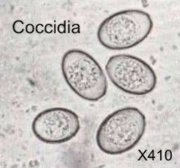
Timing of herbal treatment is important. There is some conflicting information. Considering everything I have learned, the best time to treat is after the new moon and before the full. This period gives the best opportunity to interrupt the egg cycle of the internal parasites.
Finally, our current herbal only treatment may not be the most efficacious way to treat our goats. Maybe Amicus' Vet was right in this respect.
Dr. Sheaffer recommends alternating between herbal and homeopathic worming treatments for horses. Therefore, it stands to reason that we should consider incorporating alternating homeopathic and herbal treatments into our goat deworming plan.
Monday, July 14, 2014
#HomesteadProblems What To Do With The Young Roosters

Katrina and I have raised chickens here in Tryon, North Carolina, for about two years now. We have good egg-laying chickens and picked out the best eggs in our flock to incubate, hatch, and raise. However, the three eggs we hatched (this spring) all were roosters. Two of the roosters are nearly identical twin hybrids except one rooster has golden earrings, and one silver. I chased them into their coop this afternoon and took the picture above.
As I mentioned, just as these young roosters were starting to crow, their father (a Wyandotte) suddenly died. (We think it might have been a poisonous snake or insect.) That left the hens temporarily in charge until the young hybrid roosters got big.
Their father, the Wyandott rooster who died, was an excellent rooster. He was respectful of the hens, frequently locating food for them and always looking to defend them from harm. He interposed himself between the threat (whether dog or human) and the hens. He once intervened to repel a dog attack, leaving him with a severe wound (from which he recovered). His intervention likely prevented other hens from dying (one died). The young hybrid roosters really had no time to learn discipline from their father.

The two young hybrid roosters are now dominant and are terrorizing the hens. Neither has yet become dominate over the other. They prefer to exercise their dominion over the hens in tandem. This is weird and brutal. You hear a hen scream, and see the second hybrid rooster hurry so he can join in the action. It is no wonder that most of our hens just hide out in the coop all day long.
Because of the situation, we decided to cull the two hybrid roosters. They are great beautiful roosters, but on balance, we believe the BCM rooster would make a more awesome sire.
This is all just background for the problem. Ok, here it is. What are your opinions on what we should do with the hybrid roosters?
1. Should we sell them on craigslist; or
2. Eat them.
One final factor to consider before you comment. We think the quality of the meat will be excellent. These birds have been raised on non-GMO grain and free range food. We expect the meat to be different from anything you can buy at a grocery store, and we are curious to taste it.
Sunday, June 8, 2014
Poison Ivy as a Productive Crop

Most people give up on making use of poison ivy and spray it with a herbicide. Aside from the health risk, there are three practical problems with this approach.
- Herbicide detrimentally affects other plants and animals;
- Herbicide costs a lot of money for each application, and takes a lot of energy to apply; and
- You lose the stored energy manifested in the poison ivy plant.

We bought the following supplies for our temporary fence project:
1. From Timeless Fencing, fifty 40" Step-In Posts.
2. From Premier Sheep Supplies, three 660' spools of 4.5 Intellirope electric fence cord, three Supareel T-post brackets, and a Patriot P10 battery energizer kit.
3. From the local Walmart, a 12 volt deep cycle marine battery.
I know these were capital expenses that probably exceeded the cost of a few gallons of Roundup. But unlike Roundup, this was a one time expense, it is natural, and using them, we will make productive use of poison ivy.

To set up the system, we connected one end of the Intellirope to a post. Then, using the spools, we strung the wire around the circuit hanging three strands on the Timeless temporary fence posts. At the end of the circuit, we hung the rope spools on a T-post using the Supareel brackets. Next, we installed the ground rod, wired the strands to each other, and hooked up the energizer, fence, and battery. The electric rope fence energized as soon as the clamp hit the post.
Our goats are very happy to be out of the sun. They are enjoying the browse in the wooded area and eating a lot of poison ivy. They love it.
I will post an update later to show you how the plan worked.
In the future, we can move our temporary electric fence and goats around and into any 500 foot patch of brambles on our place and it will not cost us anything but the time.
We now look at poison ivy as a free food source for our goats. The ivy plant converts solar energy into lots of leaves and vines. The goats convert the poison ivy leaves and vines into meat and milk.
Voila!
Poison ivy is a productive crop.
June 14, 2014 UPDATE: Three strands does not seem to be enough to contain my does in the electric fence area. They just get a running start and dodge through the lower electric rope lines. I am ordering a fourth spool, to see if that will stop them from escaping.
The other possibility is the Patriot P10 may not pulse frequently enough to deter goats. It is rated at 40 pulses per minute. This is good for preserving the battery, but makes the charger less effective if the goats can time out and scoot through between pulses.
My goats generally are not escape artists. I think there may be some bugs that are bothering them, and perhaps the shelter situation is less than what they are used to experiencing. They are pretty spoiled goats who like to hang out in a horse barn.
Monday, May 13, 2013
Handling our Bucklings Situation
Our twin bucklings are about five weeks old now and they are very healthy young goats. The scabs on their head is from the disbudding procedure described earlier on this blog here.
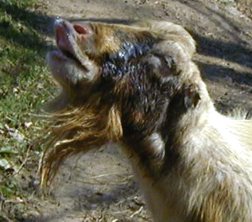 We do not want to have bucks. Bucks are nice if you want to start a herd, but we would like to keep our goat herd small. Plus, as suggested by the picture to the right, Bucks have some goat characteristics that we prefer to avoid. The picture shows a buck peeing on his own face. The upper lip is protruding so he can maximize the taste and smell the goat urine. The propensity to pee on one's own face, is probably one of the least offensive qualities of a buck.
We would like at least one or two more does, but God did not give us any this year. We are blessed with our bucklings, who we have named Johnny Bench (yellow collar) and Garcia (red collar). (I tell them apart because Johnny Bench has coloring on his forelegs that looks like shin guards.)
The video above was shot on Saturday, May 11, 2013, the day after we undertook the neutering procedure. Neutered goats are called "whethers."
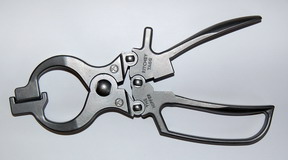 We opted to emasculate our goats with a burdizzo. FIASCO farm has a detailed description on how to undertake neutering male goats with a burdizzo here. We used a Richey Nipper tool (see left).
As recommended, we gave the young goats a tincture called Ow-Eezz to prepare them before we undertook the process. The process itself did not take long, only about five minutes per goat. The young goats were pretty sore for about two hours afterwards. The next morning, they were up and jumping around as normal. As you can tell if you watch the video, they are forgiving creatures.
Wednesday, April 24, 2013
Disbudding Kids
There are arguments for not disbudding goats. One, the horns are defensive and help to deter predators. Two, and more importantly, the horns aid the goat's circulatory system. A lot of blood flows through a goat's fully developed horns. The system helps a goat body adjust to extremely hot and cold weather. These are good reasons why a person would choose not to disbud her goat.
However, there are some negative aspects of horns. First, horns can be dangerous to other animals and people. Second, horns can be dangerous to goats in that they may cause a goat to become hung in fences or other objects.
We chose to disbud our kids for several reasons. First, our two adult does are disbudded so they would be disadvantaged in a herd of goats some of which have horns and some of which do not. Secod, we live in the temperate climate of the North Carolina piedmont so the circulatory system benefits of horns are less necessary at our homestead than in a more extreme environment. The primary factor for us was safety. We do intend to apply a paddock shift with the goats and they will encounter lots of fences. They also will be on pasture with our horses. The risk of a veternarian bill to treat a potentially disemboweled horse would be a problem for our family.
We gave our goats Ow-eze before the process. This herb intoxicated the animal. The procedure involved a small, narrow box. The four-day old kid was inserted into the box, which had an opening and lip on one end for his head. The kid's head was held against the lip and the tool, a hot iron made into a small circular ring, applied to and around the horn area. After burning the head, a spray was applied to the injury and the kid was returned to the herd.
Immediately after the procedure, one of the two kids seemed a bit disoriented (perhaps partially from the effects of the Ow-eez), but within an hour, the two bucklings were both running and jumping as if the experience and injury were totally forgotten.
Monday, April 22, 2013
Monday, April 15, 2013
Sunday, March 31, 2013
Thinking about Chicken Paddocks
The problem is that we are planting beds. We like flowers and plants growing there. The chickens dug up and destroyed my wife's daffodill bed. They dug up my row of onions, wiping out mostly all of my onion plantings in one location. (Fortunately, they have not yet destroyed my other three onion beds.)
We just acquired six additional chickens. A flock of ten could be destructive to our planting efforts. Therefore, we are thinking of a means to contain our chickens.
Paul Wheaton's Raising Chickens 2.0: No More Coop and Run has some analysis on keeping chickens.
A thread on Permies discusses the chicken paddock shifting concept and throws out ideas here and there.
A mobile chicken coop is foremost on our thoughts now. That will be needed if we are to paddock shift the chickens.
Possible construction materials for light weight coop that can be moved:
- Mesh wire;
- Polyethylene tubing;
- Metal tubing.
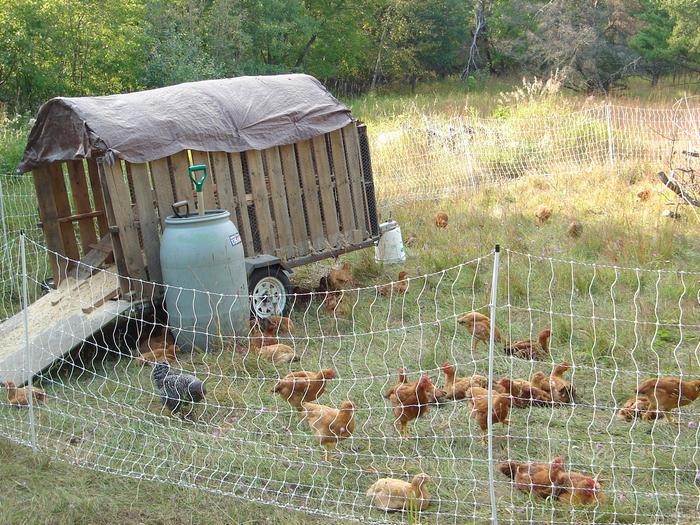
Alternatively, find an old trailer like the one pictured above. May visit my neighbor to see about his broken down trailers. He wants to sell one.
Most chickens do not fly over the floppy plastic netting. They like to fly up and light on a taught top, then hop on. The floppyness of a soft plastic wire netting keeps them from going over without wing clipping. If you get a rogue, then you can hobble her.
Sunday, March 17, 2013
paddock shifting video by greg judy
Here is a video of a presentation by Missouri farmer Greg Judy on paddock shifting. Very nice concept.
Saturday, March 16, 2013
Chicken Flock Additions
 We are stocking up on our depleted chicken flock. We now have only four chickens, two of which are poor producing Production Reds.
We aimed to buy hens that would provide a variety of egg colors.
The first addition is pictured to the left, ostensibly the Ameraucana. This breed produces medium-sized "Easter" eggs, light blue-greensish in color. We bought ours from the local feed store.
This chick, like most sold by commercial hatcheries, is more likely a mongrel rather than a true breed. Of course, since we are not breeding chickens that is perfectly fine with us.

These birds are "dual purpose" and were originally raised for meat birds. Generally speaking, meat chickens do less well free-ranging as our girls live.

They were straight run chicks, meaning we do not know if we bought three hens, three roosters, or any combination thereof. The good news is my wife said that we may get to keep a rooster if we have one in the three chicks.
The Wyandotte breed is much like the Buff Orpingtons. They also lay brown eggs, maybe slightly more productive. They are docile chickens.
We also are very happy with our guinea's defense of the chicken flock. All his other species mates were killed by predators going into the winter. However, our lone guinea survived and is the rooster of our flock of four free-ranging hens. He watches for hawks, stands off dogs, and chirps at strangers and for lost hens. He does a really good job in this capacity.
Guineas are also capable of producing some decent meat. I haven't tasted guinea but it is said to be a cross between turkey and chicken, or a juicy pheasant flavor.
Subscribe to:
Posts (Atom)