Showing posts with label Beekeeping. Show all posts

Tuesday, May 7, 2013

Bee Hive Update

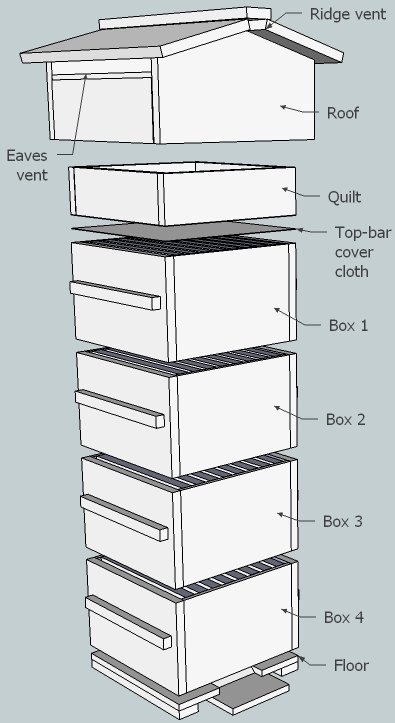
On May 2, 2013, I added a honey super, quilt, and roof to the bee hive. The picture to the left shows the construction of my first hive.

Starting with the top down, this posts discusses the new parts and the thinking behind them.

The telescoping roof was made with pine boards.  I tested it and it appears water tight.  The roof fits over top of the quilt.

The quilt is made from a medium narrow super.  I stapled burlap to the bottom of the empty box. Then, I filled it up with some alfalfa hay and pine shavings to about 1/2.   This is an insulation layer for the bees.  Hopefully, it will keep the hive cooler.  The idea is based on Warre' Hive design.

The last new piece was the medium super.  Like the bottom two hive bodies, it is full of foundationaless frames.  They do have starter strips of wax.  I glued them into the grooves of the frame top bars and tacked them down with a couple finishing nails.

I have another medium super that I will add eventually.  Don the Fat Bee Man does not recommend that you put too much empty space into a hive or it will demoralize the bees and set them back.

I also removed a plastic sheet that slid under the screened bottom board.  With spring having sprung, I don't think we are going to have anymore freezing nights.

All the new hive parts, like the old, are treated with linseed oil.  I used green spray paint on the roof for a little color and to match our house.

When I opened the hive, I discovered the bees had started building four combs in the second hive body.  The comb was white and empty except for bees crawling on it.  It is encouraging that the bees were already working hard on filling the second hive body box with drawn comb.  The drawn comb was beautiful.  I'm glad I didn't mar the bees work with foundation.

Note, some of the wax starter strips on the top bars in the second hive body were dangling down into the hive body.  I figure the bees will work around those.  Hopefully, the comb will keep going on straight.  I glued the starter strips to the top bars of the medium super so maybe it will hold this time.

Wednesday, January 23, 2013

NC State: BEES System Low-Cost Education

NC State offers low-cost education for beekeepers through the BEES System.  This looks like an excellent educational opportunity.  It's $25 for each course.  The beginner beekeeping program costs a total of $75.  If you pass the NC State test, the university will issue a electronic BEES Certificate of Completion.


Friday, January 18, 2013

North Carolina Bee Laws Impact Hive Choice

I am starting two bee hives this spring. I've been doing a lot of thinking about the Warre' bee hives, and decided to start my bees in two types of hives.  Here is my rational.

I still like the idea of natural beekeeping with a Warre' hive.  The absence of work is certainly an appealing aspect.  However, the fact is that North Carolina laws discourage use of Warre'.  If we intended to be just a hobby beekeeper, then the Warre' is no problem. However, I don't like giving up flexibility because of the North Carolina beekeeping laws.  Who knows, maybe in the future we might want to explore the commercial aspects?  If there is any real interest, maybe it would be a good livelihood for Jackson?  There could be tax advantages for our family.

Besides, if we were to go into a commercial venture with bees, we are well-positioned.  We intend to raise natural, small-cell bees mixed with ferel stock.  Ferel bees are thougth to be survivors.  They are the colonies that survived mites, beetles, and bears. By natural selection, they fight attacks on the hives more effectively.  Small cell bees, likewise, because of their small stature, are possibly more resistent to parasites.  Combined, the two genetic lines of bees should be strong.  Tryon bees could be marketable.

From a small business standpoint, an investor who has a feel for the movements in the country has an advantage.  I believe there is now a small but growing movement in America in the direction of sustainable, small-scale practices in agriculture, and also toward a more naturally-focused health care system.  Bees will be a part of both of those related movements.  There is going to be a market for bees to natural beekeepers.  There is a growing market for the healthy, chemical-free byproducts produced by bees.

The North Carolina State law prohibits sale of bees without state certification.  You cannot get the certification unless the hives are inspected.  The policy is to insure that North Carolina bee vendors are not selling diseased bees and spreading stuff like American foul brood.  Therefore, to go into the bee selling business you need state certification following an apiary inspection.

Completing inspection of brood cells in aWarre' hive could not be done unless you tore apart the hive.  The standard Warre' hives are designed to stay connected except to add more space or harvest.  You cannot easily pull out brood frames for inspection with a standard Warre' hive. Consequently, if we just have Warre' hives we will be unable to obtain state certification.

Therefore, we are buying one Langstroth hive.  Langstroth is the standard hive with the removable frames.

There are still a lot of options within the Langstroth hive choices.  Primarily, so the hive is esI am choosing the 8-frame medium boxes.  These are lighter than the ten frame varieties.  Medium boxes are smaller than the deep boxes.

I also will start these hives with foundationless frames.  I could use plastic frames, but I am not sure I want plastic in my hive because of our aim for natural beekeeping.

I could use wax comb foundations, but the wax could come from hives where bees were chemically treated. This introduces chemicals into my hives through the wax.  I am using wax starter strips.  This wax may have been chemically treated, but most of the comb will be drawn out by the bees.  I figure the chemical threat is minimal.  Over time, as our natural wax comb is incorporated, the chemical inputs will diminish further.

My bee jacket, veil, hive tool, and smoker arrived by package yesterday.  I ordered the unassembled, Langstroth hive shown above today from Brushy Mountain Bee Farm.

Thursday, January 17, 2013

Warre Hive Construction

This post journals my efforts to build a Warre' Hive.  I am using the online guide at The Bee Space.

Yesterday, January 12, I began acquiring materials for the build.  These include the following:

  1. (1) 1″x12″ pine shelving 
  2. (3) 1 x 10" pine shelving (total 30 - 60 board feet p/hive)
  3. (1) 14″x14″ 3/8 inch plywood
  4. Flathead wood screws, guage 4 or 5, length 2 inches; 
  5. 5d galvanized nails (pins for bars; barely longer than the 3/8" thick top bar)
  6. 4.5 to 5 square feet of cloth (or 1.5 yards of canvas when cut from a 60″ roll)
  7. Linseed Oil
Couple notes on the materials.  First, the size of the Warre' boxes are 210 mm (about 8 1/4 inches) tall. Therefore, the 12" shelving recommended is a bit long so there maybe some scrap wood. 

Second, it looks like I will need a table saw or router to cut the bevel for the top of the boxes in the hive, or I will need to cut the rebate with a circular saw. This bevel is on two opposite sides and is where the top bars are placed.  I don't have a table saw or router so the circular saw is the tool of choice.  

January 17: Over the past few days, I tryed to hone in on some of the practical decisions associated with the first two Warre' hive builds. 

Frames: The Warre' hive construction above does not contain foundationless frames, only the top bars.  The disadvantage of building the hive with only top bars is that it is much more difficult to inspect. 

In North Carolina, if we at our homestead ever progress with beekeeping to the point of selling bees, we would need to obtain a state certification. This is only issued after a hive inspection. Thus, a lack of frames would impede the needed steps needed for certification.  

Frames take up additional space in the cavity of the hive. Thus, frames in a Warre' argue for enlarging the dimensions of the hive body by a few inches in all directions to accommodate the frames.  

One solution would be to build slightly larger Warre' hives than the specs suggest.  Later, should we decide to introduce frames into these two hives, we could do so.

Alternatively, we could just build these standard.  If expanding our beekeeping is later advisable for our homestead considering the potential bee predators (skunks, european hornets) here, then we could make all the new hives modified Warre' hives or build medium Langs.  Considering everything, at this point, we are going to use the standard dimensions for these first hives.

Screened Bottom Board: The guide above uses a solid bottom board.  There are two disadvantages.  One, the possibility of verroa mite infection is increased with a bottom board because the mites that fall off bees can jump onboard a new host.  Second, it is impossible to see what is happening in the hive.  Without the screened bottom board, your evaluation of colony growth is limited to the density of bees at the front entrance of the hive.  With a screened bottom board, one can crawl underneath and peer up and into the hive to see if the bees are building comb in the bottom hive box.  

Some argue that Warre' did not include a screened bottom board in his design because of the environmental impacts.   Wind might displace the warm air in the hive. Others argue that the wind cannot displace the warm air because of the quilt.  Moreover, since heat rises, the relatively colder air underneath also will not displace the warm air by convection.  

Considering all elements, I will try to use a screened bottom board.  This link shows how one person designed it.  


Saturday, January 12, 2013

Type One Beekeeping Decision-making

I have been reading and listening to podcasts about beekeeping now for several weeks.  The podcast I have found most useful was Craig's the Organically Managed Beekeeping Podcast and Forums.  This post summarizes some of what I have learned, and explains why I am heading in the direction of natural beekeeping.  Please bear in mind that I am a total novice with no beekeeping experience whatsoever. Take these thoughts from one just sticking his toe in the beekeeping water.

The Type of Hive


From my research, I have learned that there are several dramatically different styles of hives.  Which style you choose determines the mechanics of taking care of the bees.  Depending on your choice, many beekeeping skills and practices are dissimilar.

The Langstroth Hive is the the predominant type in the United States.  Commercial beekeeping practices in the past 100 years gravitated to Langstroff Hives.   Those hives are designed to maximize honey production.  With the use of mechanical extractors, the honey harvest can be streamlined and made more efficient.  Langs use frames so that bees do not need to build their own comb.  The theory is that the bees can go right to work inside the Lang frames and that will increase production.

One advantage of Langs is that you have standardization.  Most beekeepers in America use Langs so the hive equipment is readily available.  Also, you have more mentors about with experience.  If you join a local beekeeping club, you will meet mostly people working Langstroth hives.

On the other hand, an older style of beekeeping is the more-natural style, top bar hives.  This top bar beekeeping practice forces the bees to build their own comb.  The bees build comb down from the top bars.  With the top bar style, extractors are not generally used to harvest honey.  The general consensus is that the honey harvest using top bar beekeeping is smaller.

One advantage of the top bar style of beekeeping is that the costs to build a hive are lower.  Primarily, this is because you do not need the expense of frames (which last only two or three years).  Also, mechanical extractors, which are expensive, are not used to harvest.  Instead, top bar beekeepers use a technique called crush and strain.

There are several types of top bar beehives.  The most common types are the Kenyan anTanzanian top bar hives. Both of these type hives (which are shaped differently) are horizontal top bar hives.  The bees create comb in half the top bar hive. As the hive grows, the beekeeper removes some wood to open up the other parts of the hive.

A disadvantage with horizontal top bar hives arises when the beekeeper is not diligent in checking on the bees.  Remember the bees build their own comb.  If the beekeeper is not diligent in directing the build, you can get something called crazy comb.  This makes harvesting honey quite problematic.

Another top bar hive is the Warre' Hive.  This is a vertical top bar hive.  It was conceived by a French researcher named Abbe' Warre' who in 1948 wrote a 12th edition of Beekeeping for All.  In this book, which is full of research about bees in general, Warre' describes in detail how to build The People's Hive, which is what he called the vertical top bar hive.

The Warre' Hive has an advantage over other top bar hives in that there is less management needed from the beekeeper.  Additionally, the building of comb vertically is more naturally akin to what bees would do in the wild.  Thus, the top bar hive seeks to manipulate the bees to encourage horizontal development of comb.  This manipulation is not unlike the Langstroth effort to force bees to build hives using the uniform, pre-made frames.

The Style of Beekeeping

A second consideration with regard to beekeeping is how the beekeeper intends to protect the bees from pests.

There are many critters that can attack a hive and cause it damage.  These include mites, beetles, and mice.  Many American beekeepers now use chemicals to combat these pests.  They have been told by the chemical companies that these chemicals are effective and perfectly safe.

However, you have to make up your own mind about whether you believe the research, including research of government.  I personally consider it mostly propaganda.

Therefore, my style gravitates to natural beekeeping. There are a minority of beekeepers who do not treat their hives with chemicals.  They use genetics to breed bees strong enough to naturally defeat the preditors.  Some use essential oils to help the bees.  Some do not.

The selective breeding and use of natural selection has allowed some natural beekeepers to breed a smaller bee.  This bee is called the "small cell" bee.  In theory, a small cell bee is better able to defeat some of the mites.

The small cell bee is also the more historically natural bee.  About 100 years ago, people began selectively breeding a larger bee.  The small cell bee is a bee that is decreasing in size, rebounding to the size of its historical ancestror.

Conclusion

I am making Type 1 decisions here.  They are consistent with sustainable practices.  They are consistent with principles of permaculture.