Showing posts with label Permaculture Design. Show all posts

Thursday, December 18, 2014

Update on our American Guinea Hogs

On November 14, 2014, we bought two young American Guinea Hog gilts (un-bred female pigs) from Cathy Payne's Broad River Pastures. (Broad River Pastures is located in Elberton, Georgia.) 

The video below shows an update on the two girls. They are smart, growing rapidly, and very healthy animals! We love them.


We are function stacking with these animals. They encourage soil life on our property. We intend to rotate the pigs to different areas over time. For now, we have them rooting about in a small stand of white oak, hemlock, dogwood, pine, and beech trees. The pigs are digging in the ground for acorns, roots, and nuts, and at the same time, enhancing the soil quality by encouraging aerobic microscopic soil life. 

Improving our soil biology is just one of the functions of our cute AGHs. If you want to know about the improved soil biology that we are aiming to achieve with all of our diverse set of animals, we recommend you read the scientific work of Dr. Elaine Ingham at her blog.  


Wednesday, August 13, 2014

Why I Need to Know if My Trees Are Champion American Chestnuts

We have two large, fruitful chestnut trees on our homestead. 

In the early 20th century a lethal Asian fungus infestation (known as the chestnut blight) swept across native habitat of the American chestnut tree and wiped out about 4 billion American chestnuts.  In circa 1925, the fungus reached our ecosystem in western North Carolina killing the American chestnuts here.

Most chestnuts growing now are Chinese chestnuts or hybrids. The Chinese chestnut species has an immunity to the blight. However, the American Chestnut Foundation is using science to seek out and restore blight-resistant American chestnut trees to our biome.

The first option for the American Chestnut restoration project is to locate naturally-resistant all American (not hybrid) trees. Champion trees could save the species. A champion would have a natural immunity to the blight, and would be capable of passing that immunity down to her children through her seeds. Here is an article about the ACF restoration project: Restoring the American Chestnut Tree. Another good piece is Chestnut Champions by Meghan Jordan, TACF, Page 12. 

There is only a very slight possibility we have American chestnuts on our homestead. There is an even smaller probability still that our chestnuts are champions. But even the faintest possibility of a champion chestnut tree on our homestead creates a duty to check. That is why we must identify our chestnut trees. We owe it to our ancestry and progeny. Stay tuned.

Sunday, June 8, 2014

Poison Ivy as a Productive Crop

One thing that I have noticed about poison ivy is that it produces quite a bit of organic material. The trick is using the stuff in a productive way. In this post, we look at how we set up a system to use goats to convert a poison ivy patch to food.

Most people give up on making use of poison ivy and spray it with a herbicide. Aside from the health risk, there are three practical problems with this approach.

          1. Herbicide detrimentally affects other plants and animals;
          2. Herbicide costs a lot of money for each application, and takes a lot of energy to apply; and
          3. You lose the stored energy manifested in the poison ivy plant.

Besides, we are natural gardeners and do not want to use herbicides on our place. We don't like it.

We bought the following supplies for our temporary fence project:

1. From Timeless Fencing, fifty 40" Step-In Posts.

2. From Premier Sheep Supplies, three 660' spools of 4.5 Intellirope electric fence cord, three Supareel T-post brackets, and a Patriot P10 battery energizer kit.

3. From the local Walmart, a 12 volt deep cycle marine battery.

I know these were capital expenses that probably exceeded the cost of a few gallons of Roundup. But unlike Roundup, this was a one time expense, it is natural, and using them, we will make productive use of poison ivy.


To set up the system, we connected one end of the Intellirope to a post. Then, using the spools, we strung the wire around the circuit hanging three strands on the Timeless temporary fence posts. At the end of the circuit, we hung the rope spools on a T-post using the Supareel brackets. Next, we installed the ground rod, wired the strands to each other, and hooked up the energizer, fence, and battery. The electric rope fence energized as soon as the clamp hit the post.

Our goats are very happy to be out of the sun. They are enjoying the browse in the wooded area and eating a lot of poison ivy. They love it.

I will post an update later to show you how the plan worked.

In the future, we can move our temporary electric fence and goats around and into any 500 foot patch of brambles on our place and it will not cost us anything but the time.

We now look at poison ivy as a free food source for our goats. The ivy plant converts solar energy into lots of leaves and vines. The goats convert the poison ivy leaves and vines into meat and milk.

Voila!

Poison ivy is a productive crop.

June 14, 2014 UPDATE: Three strands does not seem to be enough to contain my does in the electric fence area. They just get a running start and dodge through the lower electric rope lines. I am ordering a fourth spool, to see if that will stop them from escaping. 

The other possibility is the Patriot P10 may not pulse frequently enough to deter goats. It is rated at 40 pulses per minute. This is good for preserving the battery, but makes the charger less effective if the goats can time out and scoot through between pulses. 

My goats generally are not escape artists. I think there may be some bugs that are bothering them, and perhaps the shelter situation is less than what they are used to experiencing. They are pretty spoiled goats who like to hang out in a horse barn.


Sunday, April 14, 2013

Geoff Lawton: Surviving Collapse--The Property Purchase Checklist

I just finished watching Geoff Lawton's second free video in his survival permaculture series.  This one is really good. I am happy I watched it before I started working on the earthworks on my homestead.  

Unfortunately, our home is located on the top of the hill, a site that is criticized in the video because its access to pressurized water is limited.

The image to the right is one of the graphics Geoff uses to illustrate basic permaculture design principles.  There is plenty of action shots, white board discussion, and generallized planning considerations for a new property.  

I liked the discussion on the impervious roadway.  I have one that bisects my property and it is causing some erosion problems.  


Highly recommend the video. To see the video, you must sign up for Geoff's email list. He promises to keep your email confidential.   The link to gain access to the video his here.
 

Sunday, March 31, 2013

Thinking about Chicken Paddocks

We have been free-ranging our little flock of four chickens.  They are good egg producers, with mostly superior quality.  We attribute the quality to the amount of protien the chickens obtain by freely attending to the most productive (i.e., wormy) areas of our property.

The problem is that we are planting beds.  We like flowers and plants growing there.  The chickens dug up and destroyed my wife's daffodill bed.  They dug up my row of onions, wiping out mostly all of my onion plantings in one location.  (Fortunately, they have not yet destroyed my other three onion beds.)

We just acquired six additional chickens.  A flock of ten could be destructive to our planting efforts.  Therefore, we are thinking of a means to contain our chickens.

Paul Wheaton's Raising Chickens 2.0: No More Coop and Run has some analysis on keeping chickens.

A thread on Permies discusses the chicken paddock shifting concept and throws out ideas here and there.

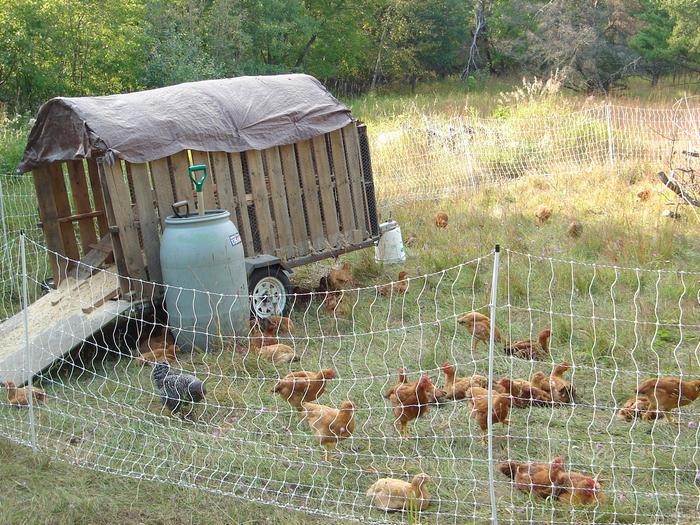
A mobile chicken coop is foremost on our thoughts now.  That will be needed if we are to paddock shift the chickens.

Possible construction materials for light weight coop that can be moved:
  1. Mesh wire;
  2. Polyethylene tubing;
  3. Metal tubing.
Alternatively, find an old trailer like the one pictured above.  May visit my neighbor to see about his broken down trailers.  He wants to sell one.

Most chickens do not fly over the floppy plastic netting.  They like to fly up and light on a taught top, then hop on.  The floppyness of a soft plastic wire netting keeps them from going over without wing clipping.  If you get a rogue, then you can hobble her.  


Sunday, March 17, 2013

paddock shifting video by greg judy

Here is a video of a presentation by Missouri farmer Greg Judy on paddock shifting.  Very nice concept.


Tuesday, February 26, 2013

Pasture Rotation Paddock Size Calculation


We have three horses.  Combined, they weigh about 3,000 pounds.  Using that figure, we can start to figure out the rotational grazing needs for our homestead.  Our horses eat a combined 80 pounds of dry forage per day.

We currently have about 4.5 acres of pasture.  First we need to figure out the grazable height of forage.  Estimate the height of grazable grass and legumes and clover (excluding seed heads, etc., which are not grazable).  Then, subtract three inches to deduct the non-grazable portion.  The difference is the height of grazable dry matter.

Next, use a "pasture stick" to estimate the quantity of dry matter in the pasture.  This figure gives you a number of grazable dry matter.

This is a total guess, but I estimate that we have about 1200 pounds of dry matter in each acre.  Based on this, it will take the horses about 15 days to eat most of an acre paddock of forage.  Need to get a pasture stick.

A rule of thumb is to graze animals when grass is 6 to 8 inches high. Rest grass when it is grazed down halfway (3 to 4 inches high).  “Graze ½, leave ½.” 

We need to establish five paddocks and rotate the horses through them.  


Tuesday, January 22, 2013

Earth Users Guide to Permaculture

This weekend, I finished Rosemary Morrow's earth user's guide to permaculture, 2d ed., (Chelsea Green Pub. Co. 2006). The book is written in clear sentences. I really liked Rob Allsop's illustrations.

The book has five sections:
  1. Observing;
  2. Ecological;
  3. Applying;
  4. Resilience; and 
  5. Social.
Each section has substantial merit and so much meat that it will take review and contemplation to take it in and understand its breadth and scope. The application section by itself is worth buying the book.  

A couple notable chapters were 
  • climates and microclimates (ecological);
  • trees, forests, and windbreaks (ecological)
  • developing your design methods (applying)
  • a chapter each for permaculture zones zero to five (applying)
  • design for disaster (resilience)
  • pest management--IPM (reslience)
  • aquaculture (reslience)
The book tends to devolve slightly into political environmentalism from a governmental perspective.  I am not sure how the authors would feel about individual liberty philosophy. Clearly, that is a trait that many permaculturists exhibit. That said, the political crap is definitely a far-backseat to the practical principles that Morrow clearly explains in her excellent book 

Now I just need to apply some of the stuff I learned.  

Thursday, January 3, 2013

Earthworks Design and Water Conservation Drawing


The drawing above shows our planning for installing three cisterns, and building earthworks, two rain gardens, and a pond.  The drawing also indicates the location of water slowing devices located along a ditch forming down the south side of our gravel driveway.  The contour runs generally southward.  The house is located at the top of the hill.

According to the Technical Guidance: Stormwater Treatment Credit for Rainwater Harvesting, we will need cisterns about the house capable of handling 3,000 gallons of 24-hour water flow (1 year).  This is based on government's 1 Year 24 Hour Storm Rainfall in Tryon, 3.93 inches. (See National Oceanic and Atmospheric Administration of the United States Dept. of Commerce, National Weather Service, NOAA ATLAS 14 POINT PRECIPITATION FREQUENCY ESTIMATES: (Tryon, North Carolina, US (31-8744)).

My calculations are located at this link.

Friday, December 28, 2012

Art Ludwig on Water Storage

Started the book Water Storage, Tanks, Cisterns, Auqifers, and Ponds, Art Ludwig (Oasis Design May 30, 2005).  

The book discusses general design principles for construction and use water systems on your land.  I haven't finished reading the book yet, but it is full of detailed drawings and suggestions for avoiding common mistakes.  It has a good analysis of how to choose the best system for your homestead, helping to decide the kinds of storage to use, be it tanks, groundwater, or ponds.

Thursday, September 20, 2012

Mission Statement

Chestnut Permie Farm
The mission of this blog is to document and explain one family's goal of establishing a sustainable homestead in western North Carolina.

The subject matter is expected to focus on land management, livestock, and gardening methods and efforts.

Our goal includes not using synthetic chemicals, pesticides, fungicides on our farm. We mostly plant open pollinated heritage seeds.  We try to follow a no till policy, and restore and maintain our soil with rotational grazing animals, composting, poly-culture planting, and mulch.  We try to follow the principle of returning the surplus to the earth.

We hope you enjoy reading occasional posts as we progress with our mission.