Wednesday, April 24, 2013

Disbudding Kids

Our young bucklings are now going on two weeks old. At age four days, we undertook to disbud the young kids.

There are arguments for not disbudding goats. One, the horns are defensive and help to deter predators. Two, and more importantly, the horns aid the goat's circulatory system. A lot of blood flows through a goat's fully developed horns. The system helps a goat body adjust to extremely hot and cold weather. These are good reasons why a person would choose not to disbud her goat.

However, there are some negative aspects of horns. First, horns can be dangerous to other animals and people. Second, horns can be dangerous to goats in that they may cause a goat to become hung in fences or other objects.

We chose to disbud our kids for several reasons. First, our two adult does are disbudded so they would be disadvantaged in a herd of goats some of which have horns and some of which do not. Secod, we live in the temperate climate of the North Carolina piedmont so the circulatory system benefits of horns are less necessary at our homestead than in a more extreme environment. The primary factor for us was safety. We do intend to apply a paddock shift with the goats and they will encounter lots of fences. They also will be on pasture with our horses. The risk of a veternarian bill to treat a potentially disemboweled horse would be a problem for our family.

The procedure is to burn the young kid's head where the horns are just beginning to grow. The burning, if done successfully, destroys the goat's glands that cause the horns to grow. Our bucklings were disbudded at day five. Even at day five, you could feel the developing horns growing in the kids.

We gave our goats Ow-eze before the process. This herb intoxicated the animal. The procedure involved a small, narrow box. The four-day old kid was inserted into the box, which had an opening and lip on one end for his head. The kid's head was held against the lip and the tool, a hot iron made into a small circular ring, applied to and around the horn area. After burning the head, a spray was applied to the injury and the kid was returned to the herd.

Immediately after the procedure, one of the two kids seemed a bit disoriented (perhaps partially from the effects of the Ow-eez), but within an hour, the two bucklings were both running and jumping as if the experience and injury were totally forgotten.

Sunday, April 14, 2013

Geoff Lawton: Surviving Collapse--The Property Purchase Checklist

I just finished watching Geoff Lawton's second free video in his survival permaculture series.  This one is really good. I am happy I watched it before I started working on the earthworks on my homestead.  

Unfortunately, our home is located on the top of the hill, a site that is criticized in the video because its access to pressurized water is limited.

The image to the right is one of the graphics Geoff uses to illustrate basic permaculture design principles.  There is plenty of action shots, white board discussion, and generallized planning considerations for a new property.  

I liked the discussion on the impervious roadway.  I have one that bisects my property and it is causing some erosion problems.  


Highly recommend the video. To see the video, you must sign up for Geoff's email list. He promises to keep your email confidential.   The link to gain access to the video his here.
 

Sunday, March 31, 2013

Thinking about Chicken Paddocks

We have been free-ranging our little flock of four chickens.  They are good egg producers, with mostly superior quality.  We attribute the quality to the amount of protien the chickens obtain by freely attending to the most productive (i.e., wormy) areas of our property.

The problem is that we are planting beds.  We like flowers and plants growing there.  The chickens dug up and destroyed my wife's daffodill bed.  They dug up my row of onions, wiping out mostly all of my onion plantings in one location.  (Fortunately, they have not yet destroyed my other three onion beds.)

We just acquired six additional chickens.  A flock of ten could be destructive to our planting efforts.  Therefore, we are thinking of a means to contain our chickens.

Paul Wheaton's Raising Chickens 2.0: No More Coop and Run has some analysis on keeping chickens.

A thread on Permies discusses the chicken paddock shifting concept and throws out ideas here and there.

A mobile chicken coop is foremost on our thoughts now.  That will be needed if we are to paddock shift the chickens.

Possible construction materials for light weight coop that can be moved:
  1. Mesh wire;
  2. Polyethylene tubing;
  3. Metal tubing.
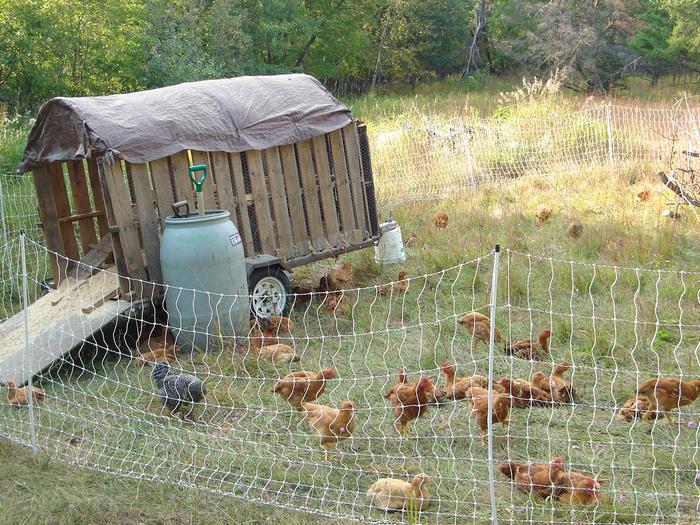
Alternatively, find an old trailer like the one pictured above.  May visit my neighbor to see about his broken down trailers.  He wants to sell one.

Most chickens do not fly over the floppy plastic netting.  They like to fly up and light on a taught top, then hop on.  The floppyness of a soft plastic wire netting keeps them from going over without wing clipping.  If you get a rogue, then you can hobble her.  


Sunday, March 17, 2013

paddock shifting video by greg judy

Here is a video of a presentation by Missouri farmer Greg Judy on paddock shifting.  Very nice concept.